Wednesday, 4 November 2020

Wednesday 4th November

A significant change in the weather with the first frost overnight under clear skies in a dominant high pressure (1038 mb and climbing); and the calm condition allowed the first estuarine fog to develop. As predicted, overhead passage was heavy with 37,575 Woodpigeon that flew WSW from 07:10 to 11:25. This the fourth largest count here ever and all previous 5-figure counts have been since 2007, underlining what is a growing awesome annual spectacle. There were also 5-figure counts reported today elsewhere in south Devon (here). Relatively few compared to some movements in the past, 38 Stock Dove represented only 0.1% of pigeons on the move.

The following counts also include birds that spent some time in Greenland Lake, or flew NE up the spit and double-backed - 184 Skylark (W), 124 Chaffinch (NE), 60+ Goldfinch, 30+ Greenfinch, 30 Siskin (NE), 28 Meadow Pipit (N), 26 Linnet (NE), 20 Jackdaw (WSW), seven alba wagtail plus a White Wagtail (WSW), five Song Thrush (WSW), four Bullfinch (double-backed), three Rook, three Brambling (NE, one landed briefly in The Spinney), three Lesser Redpoll, three Grey Wagtail, two Fieldfare (NE), two Great Northern Diver (looped over the spit), two Reed Bunting, a Buzzard, a Coal Tit (NE; britannicus), a Mistle Thrush (W), a sw Mediterranean Gull (N), a Golden Plover (N) and a male Yellowhammer, perhaps yesterday's bird.

In the woodlands, 13 Long-tailed Tit and a few other tits, at least five each of Chiffchaff and Goldcrest, and one observer heard a Firecrest, perhaps yesterday's bird. One of the three Great Spotted Woodpecker appeared exhausted and grounded in Marram-grass toward Warren Point, which could have been a migrant.  Late morning, a small pipit that called a couple of times and briefly landed in Greenland Lake before it flew off NE was considered to be just a Tree Pipit. This is the latest date ever here and beats the previous late date record of 25 Oct 1958.

On the Main Pond, a few Water Rail, Moorhen, a pair of Little Grebe and the drake Shoveler.  The morning high tide was missed to concentrate on 'vis-mig'. At low tide, 23 Cattle Egret perched on the wreck.  A brief look offshore revealed a flock of 20 Common Scoter and a couple of Gannet. An impressive 83 species were recorded on site today.

Wildlife news: a late Clouded Yellow and one or two Red Admiral, Common Darter and Migrant Hawker were on the wing in the sunshine. Water Vole was present on the Main Pond.

Tuesday, 3 November 2020

Tuesday 3rd November

A short seawatch after dawn produced 18 Gannet, four each of Great Northern Diver, Common Scoter and Kittiwake, and a Great Crested Grebe (plus four more in the estuary).

Rain and a fresh westerly that persisted until 10:00 interrupted overhead migration that pushed through during less wet spells and then resumed after the weather cleared up and continued into the early afternoon. Passerines moved at various heights and in different directions, and given the conditions only approximations and underestimates were possible. The main event was 5,980 Woodpigeon (WSW) accompanied by an unusually small proportion of six Stock Dove.  The first big movement of the late-autumn and right on time in comparison to previous mass movements of pigeons spp.  

Also on the move, 85+ Chaffinch (NE & SW), 45+ Skylark (W), 35+ Meadow Pipit (including grounded birds); 28 Siskin (NE & SW), 23 Lesser Black-backed Gull (S), 17 Jackdaw (W), six Rook (NE & SW), three Grey Wagtail (NE) and two Lesser Redpoll (NE).

A vocal Yellow-browed Warbler moved NE through the Entrance Bushes and behind Crocus Compound at c.10:15, where there was also a showy vocal Firecrest. A mixed feeding flock contained 15 Long-tailed Tit, 13 Blue Tit and three Great Tit, and scattered in wooded areas were four Goldcrest, three Chiffchaff, two Great Spotted Woodpecker, two Song Thrush, a Coal Tit and a Bullfinch.

Around Greenland Lake and surrounding brambles, the finch flock swelled a little with assumed grounded migrants to include 49 Goldfinch and 24 Greenfinch, and in this area there was also two Song Thrush, two Reed Bunting and the year's second Yellowhammer. A flock of 14 Linnet favoured the golf course. Also six Stonechat, two Kestrel and two Raven on site.

Only a few counts were made of waterbirds in the estuary on the ebbing spring tide, these were 292 Dark-bellied Brent Goose plus 24 Pale-bellied Brent Goose. Also 219 Redshank, 114 Turnstone and the resident Slavonian Grebe in its inimitable version of winter-plumage. 
 At low tide, 35 Cattle Egret were out on the estuary in the mid afternoon.

Wildlife news: a couple of Red Admiral were on the wing at lunchtime.

Sunday, 1 November 2020

Sunday 1st November


Force 5-7 southerlies overnight and heavy rain that stopped a little before dawn tempted another seawatch.  The passage of 23+ Great Northern Diver was the largest count since Dec 2017 and only exceeded here on about ten previous occasions. This tied in with a slightly larger count 4.25 miles SSW down the coast off Teignmouth (see Teign Birds). Otherwise the seawatch produced little of interest, just 39 Gannet, six auk sp. (probably Razorbill), two Common Scoter and a Red-throated Diver.

Rafts of wildfowl floated on estuary waters and waders assembled in the saltmarshes and around The Bight. The American Wigeon stubbornly remained on the Exmouth side of the estuary and not among the 1,740+ Wigeon within the recording area. Other counts were 455 Dunlin, 329 Dark-bellied Brent Goose, 221 Redshank, 58 Grey Plover, 54 Common Gull, just 39 Teal, 35 Shelduck, 33 Cormorant, 33 Bar-tailed Godwit, 26 Great Black-backed Gull, 23 Pale-bellied Brent Goose, 19 Mute Swan, only ten Curlew, seven Greenshank, six Mediterranean Gull (6 adult, 1 sw), five Little Egret and three Knot, three Sanderling; also two Canada Goose, two Grey Heron, two Lesser Black-backed Gull, and single Pintail, Red-breasted Merganser, the usual drake Eider, a Little Grebe and the Slavonian Grebe. A moulting juv Curlew Sandpiper was again with the Dunlin flock.

A Water Pipit, one or two petrosus Rock Pipit and a Scandinavian Rock Pipit foraged between The Bight and the golf course saltmarsh (no public access).

Similar to previous days, a roaming mixed flock in wooded areas comprised most of the 17 Long-tailed Tit, 13 Blue Tit, four Goldcrest, three Great Tit, two Chiffchaff and a British-race Coal Tit. Also single Great Spotted Woodpecker and Bullfinch. Mobile around the site were 14 Linnet, 11 Greenfinch, ten Goldfinch and six Meadow Pipit.  Usual residents scattered about were six Cirl Bunting and a few Stonechat.

The long-staying drake Shoveler was paired up with a female, and a pair of Little Grebe trilled on the Main Pond where there was also a single female Mallard, Water Rail and a few Moorhen.

A few singles of Skylark, Chaffinch and single Jackdaw and Siskin past overhead.

Saturday, 31 October 2020

Saturday 31st October

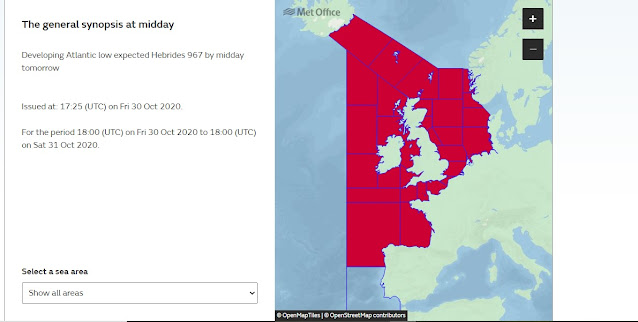
Total coverage from pre-dawn to post-dusk amounted to 10.5 hours solid birding for one of the five birders on site today. The day began with Storm Aiden that lashed down with gale force SSE until 10:30. The 'full house' for gales in last night's shipping forecast (below) instigated a 4.5 hour seawatch that was particularly rewarding. Everything detailed flew S or SSW down the coast, unless otherwise stated.

copy of Met Office shipping forecast map - acknowledgement and thanks to Met Office


An adult (or 2cy) Sabine's Gull flew through with a flock of Kittiwake 'mid-far' distance at 08:40. A small adult (male?) pale phase Pomarine Skua spent a few minutes close in and at one point flew over the seawall. A European Storm-petrel flew in toward the seawall at 09:50. And the last major highlight was after the rains had passed, a Sooty Shearwater passed at 10:55 some way out. The count of 598 Kittiwake was big and only surpassed about a dozen times here in recorded history. By contrast, 44 Gannet and single-figures each of Razorbill and Guillemot were remarkably poor.  Also, 21 Common Scoter, seven Great Northern Diver, five Red-throated Diver (plus a diver sp.) and a Great Skua. Small number of Oystercatcher, Curlew, a Bar-tailed Godwit and small number of mixed gulls struggled through, including an adult Mediterranean Gull.

Conditions flipped late morning to become pleasantly calm with warm sunshine. Perhaps due to no burning today, wooded areas were productive with a roaming flock that contained most of the 23 Blue Tit, 15 Long-tailed Tit, three Great Tit and two Coal Tit; the individual seen well was the britannicus British-race. Also four Chiffchaff, two Goldcrest and a Firecrest. A couple of Chaffinch and single Great Spotted Woodpecker and Bullfinch were also recorded.

Most finches appear to have migrated a few days ago and there remained only about 20 Goldfinch, six Greenfinch and a Siskin flew over. On the Main Pond, a Mallard and a Little Grebe.

The incoming evening high tide brought in a four-figure count of Wigeon but still no sign of the American Wigeon. Some counts were conducted and the best of these was 154 Turnstone, the highest count here since January 1989, many foraged on piles of green algae that have accumulated on mudflats out from Railway Saltmarsh. Larger counts regularly occur at their main roost on the old harbour wall at Starcross, located a little to the north of the recording area. Other counts were 359 Dark-bellied Brent Goose with two Pale-bellied Brent Goose with them; 243 Redshank, c.215 Dunlin, 184 Teal, 160 Great Black-backed Gull (including ten on the seawatch), c.40 Knot, 37 Curlew (including 13 on the seawatch), 35 Shelduck, 18 Mute Swan, c.13 Ringed Plover, seven Sanderling, five Greenshank, another four Mallard, four Lesser Black-backed Gull (including two on the seawatch), three Little Egret, two Grey Heron, two Black-tailed Godwit; also the Slavonian Grebe, the drake Eider and single Great Crested Grebe, another Little Grebe, Pintail, Red-breasted Merganser, Kingfisher and presumably the same Whimbrel. Earlier in the day, two Peregine hunted over the estuary.

In the evening around The Bight, the pre-roost flock reached 22 Linnet; a typical count of late. Of the two or three Rock Pipit present, one was the colour-ringed Scandinavian Rock Pipit.

Wildlife news: brief views of a large, butter-white and black checkered-patterned butterfly that flew out across the beach and lost from view looked very interesting but, sadly, was lost and unidentified. More standard fayre were a Speckled Wood along a wooded edge and a Migrant Hawker over the Main Pond.


Friday, 30 October 2020

Friday 30th October

With sunrise here at 07:02 and sunset at 16:51 GMT, and with Exmouth Docks high tides at 05:41 and 17:54, birding to cover both tides was still just about achievable today as daylight around this season continues to shorten by about 3 minutes per day.  A full set of waterbird counts was attempted, 1,675 Wigeon, 800+ Oystercatcher, 730+ Herring Gull, 412 Dunlin, 369 Teal, 227 Dark-bellied Brent Goose, 214 Redshank, 168 Black-headed Gull, 158 Canada Goose that departed soon after dawn; 91 Turnstone, 66 Common Gull, 61 Grey Plover, 59 Great Black-backed Gull, 39 Bar-tailed Godwit, just 38 Curlew - most of the estuary's population may be on their Exminster Marshes roost site; also 35 Knot, 32 Shelduck, 21 Mute Swan, 18 Black-tailed Godwit, 16 Cormorant, 15 Shag perched on the wreck as they do in usually small numbers during unsettled conditions; eight Pale-bellied Brent Goose, five Lesser Black-backed Gull, five Red-breasted Merganser, four Great Crested Grebe, four Greenshank, four adult winter Mediterranean Gull, three Sanderling, two Grey Heron, two Little Egret, two Common Snipe and the Slavonian Grebe.  A small number of Yellow-legged Gull were also reported.  Added together, there was in the region of 5,300 waterbirds on site today.

A few Rock Pipit including a Scandinavian Rock Pipit called in the saltmarsh.  The Merlin was back again to buzz the small waders in the evening twilight and
earlier two Raven joined Carrion Crows to predate another unidentified wader in The Bight.

Battered for days by high winds, rain and smoked out by grass burning, wooded areas only held eight Long-tailed Tit, very few other tits; also two each of Goldcrest, Great Spotted Woodpecker and Chaffinch, and single Chiffchaff and Bullfinch. Only a few finches were present in Greenland Lake. On the Main Pond, three Mallard, two Little Grebe and a Grey Wagtail. And a Stock Dove flew into Turkey Oak Copse.

Wildlife news: single Red Admiral and Small Copper in brief sunny spells, and two each of Migrant Hawker and Common Darter, also a Water Vole happily munched a Common Reed stem stood next to the viewing platform at the Main Pond.

Thursday, 29 October 2020

Thursday 29th October

Unsettled conditions continue with a series of deep depressions crossing the North Atlantic driven on a jet stream reaching 220 mph over Newfoundland and that meanders only slightly before arriving over the UK where it is still a potent 120 mph  (netweather, online). At sea level the WSW moderate to strong breeze was again disappointing at sea where c.60 Gannet and a few auk spp. passed in 45 mins. Closer inshore to find sheltered waters were two Great Northern Diver and two Red-throated Diver.

Red-throated Diver - Alan Keatley

Wooded areas predictably held the mixed flock of tits, four Goldcrest and two each of Chiffchaff, Great Spotted Woodpecker and Bullfinch. The Main Pond continued to host the drake Shoveler, a Little Grebe, the aquiline female Mallard, a few Moorhen and squealing Water Rail. Around Greenland Lake, the finch flock had reduced to c.30 Goldfinch, c.10 Greenfinch and a few Linnet. As usual, a few Stonechat and Cirl Bunting were scattered about the reserve. A late House Martin was also reported. A female Merlin over The Bight in the evening was likely the same bird seen earlier in the day.
 
Little Grebe - DW - 2020-10-29 - AKe

Same as for the past few days, most attention was on the incoming evening high tide. Wind, dankness and drizzle hampered observations and the presence of Carrion Crows continue to frustrate matters further, particularly when a lone exhausted small calidrid that raised mild interest was immediately dived on and chased into the dunes of Warren Point where it was attacked and killed. A desperate jog around by one observer was too late to save it. And the macabre theme continued as birders spotted crows pecking at a Short-eared Owl lying on the beach of The Bight, which prompted another jog, but seems that had been dead already for a few hours.

The 'AVP' colour-ringed Scandinavian Rock Pipit was again on the shoreline of The Bight and details returned by the 'Norwegian Rock Pipit Project' coordinator shared details today that it was mist-netted as a 1cy on 9th August this year at Farsund, Vest-Agder, which is at the south end of Norway. It called more convincingly today like a littoralis and its appearance, commented on yesterday as especially cryptic is possibly explained by its being a young bird.

Scandinavian Rock Pipit - Lee Collins
 
Scandinavian Rock Pipit - Lee Collins


Over 400 Dunlin appeared in The Bight and with them again were a juv Little Stint and at least one moulting juv Curlew Sandpiper. By coincidence, of the 35 Ringed Plover, the yellow-flagged 'XTX' bird was again present, ringed at Makkevika Giske, Norway, from where Dawlish Warren has had Ringed Plover before.  Those that breed there are still hiaticula, not tundrae, which breed further north. Apart from 57 Knot earlier, no other wader counts were made. 

Too dark and mostly too distant, the American Wigeon that was seen to fly towards Dawlish Warren from Exmouth this evening could not be found among the 1,380 Wigeon and 265 Teal. Also four Great Crested Grebe, another Little Grebe and the Slavonian Grebe were in the estuary.

Wednesday, 28 October 2020

Wednesday 28th October

No sign of yesterday's briefly seen Baird's Sandpiper. With 341 Dunlin, 34 Ringed Plover, four Sanderling, two juv Little Stint and the juv Curlew Sandpiper present in The Bight on the late afternoon tide, the carrying flock it was with yesterday was evidently present again today, but it was not.  The waders were less disturbed by crows today, which allowed regular checks by the small group of hopeful birders.  Again, little attention was given to the thousands of other waterbirds present and limited counts were c.15 Pale-bellied Brent Goose including the Irish-ringed returning individual, seen here again yesterday, was likely among them. The usual drake Eider and a third-winter Yellow-legged Gull were among c.50 Great Black-backed Gull that roosted on Finger Point.  Some of the 44 Cattle Egret in Eastdon Fields may have ventured into the recording area but no clear record of this has yet been received.  A Merlin again passed over The Bight.

The highlight was a 'AVP' Norwegian-ringed presumed Scandinavian Rock Pipit; details are being requested from the ringer.   Unlike last winter's yellow-ringed bird, today's bird was especially cryptic and more-or-less indistinguishable on appearances to petrosus, and audibly only once or twice was a softer less shrill littoralis-like call heard.

Tuesday, 27 October 2020

Tuesday 27th October

During a half hour period from 15:10, a juv Baird's Sandpiper was seen, sometimes only briefly among a swirling flock of c.350 Dunlin around The Bight, persistently disturbed from roosting on the waterline by foraging Carrion Crow and then to make matters worse, by a passing Merlin. Toward dusk, disturbance  abated but only two-thirds of the flock were present, along with the remaining juv Little Stint and juv Curlew Sandpiper, but the missing third of the flock spooked up the estuary, presumably took the Baird's Sandpiper with them. Many waders commute between the bottom and top end of the estuary, as seen earlier this year when a flock of Curlew Sandpiper, flushed from Dawlish Warren by a dog-walker on the golf course, re-located a short time late to Bowling Green Marsh, five miles to the NNW.  In August 1993 a Baird's Sandpiper at Dawlish Warren one day was seen at Bowling Green Marsh the next day and then back at Dawlish Warren the day after that. There are four previous records of Baird's Sandpiper here, one remained for only one tide (in August 2000) and the last record in autumn 2001 was a long-stayer.

Apart from 21 Ringed Plover and seven Sanderling also within this wader flock, most other waterbirds understandably received little attention. Dawlish Warren is notoriously harsh on birders for playing all too often only fleeting host to rarities and at least two birders actually on site failed to connect with it, and this was especially exasperating for one regular birder who saw the Baird's Sandpiper twice but constituted UTV's.  This is a common lexicon of birders and it stands for 'un-tickable view', describing the unpleasant and sometimes upsetting experience of failing to get enough detail on a bird to be sure of its identification, independently.  The last word is the important one that de-couples whatever other's say the bird is from the individual's personal experience of that bird.  Particularly with rarities, the line recognised by birders that should not be crossed is that if you can't identify the bird for yourself with reasonable confidence based only on your experience of that bird, then you can't tick or count it. This, of course, isn't limited to the actual timeframe of seeing and/ or hearing the bird, and legitimate 'ticking' of birds (or removal from lists) afterwards, after careful reflection is commonplace, and can even be years later, based on awareness to crucial details that have since transpired about a particular bird's identity and status.    

A site record of 44 Cattle Egret descended to loiter for a time in the saltmarsh corner at high tide before they flew north to their nocturnal roost on the Powderham Estate, and in a similar fashion to yesterday some first paused to forage around cattle in Eastdon Fields.

In the morning a 3.5 hour seawatch lacked quality in only 220 Gannet, 104 auk spp. that involved large proportions each of Guillemot and Razorbill; 93 Kittiwake, 20 Common Scoter and two Great Northern Diver. In the woods, four Goldcrest, two Bullfinch, two Chaffinch and a Chiffchaff. And in Greenland Lake a flock of 38 Goldfinch, nine Greenfinch; some Cirl Bunting and a Reed Bunting.

Monday, 26 October 2020

Monday 26th October

An afternoon visit in pleasant weather conditions focused on the neap tide and counts were 295 Dark-bellied Brent Goose, 269 Curlew, 171 Redshank, 141 Teal, 63 Turnstone, 32 Shelduck, 32 Knot, 31 Grey Plover, 19 Bar-tailed Godwit, 18 Mute Swan, 13 Pale-bellied Brent Goose, 11 Cormorant, just nine Great Black-backed Gull, eight Greenshank, three Great Crested Grebe, two each of Canada Goose, Mallard, Red-breasted Merganser, Black-tailed Godwit and Common Snipe; and single Ringed Plover, Whimbrel, Sanderling, Mediterranean Gull; the autumn's first intermedius Lesser Black-backed Gull, Kingfisher and the Slavonian Grebe, which has now more-or-less moulted into its uniquely odd-looking non-breeding plumage. Not counted, four-figures of Wigeon and three-figures of Oystercatcher and Dunlin were also present.

The heron split was again a sign of changing times with three each of Grey Heron and Little Egret outnumbered by 31 Cattle Egret that assembled in the estuary corner before they flew north before dusk.  Some paused in Eastdon Fields around the cattle where a few more Little Egret were also foraging, then on their way presumably toward their roost site at Powderham.

Two Little Grebe were on the Main Pond where also were the regular squealing Water Rail, a few Moorhen, drake Shoveler and single Mallard. A roaming tit flock contained some of the nine Long-tailed Tit, nine Blue Tit, four Goldcrest, three Great Tit and two Chiffchaff found in wooded areas. A scattering of Stonechat and Cirl Bunting were present, as usual. And a glance offshore produced only a distant small raft of Common Scoter and a few Gannet.

Also noted, two Kestrel, a Sparrowhawk, a Great Spotted Woodpecker and a splendid male Green Woodpecker that gave a moment of joy to a young family out for a stroll in the sunshine as it took flight. A flock of ten Pied Wagtail headed NE and a single Grey Wagtail flew N at dusk, again presumably to roost sites.

Sunday, 25 October 2020

Sunday 25th October

Strong winds continued into yesterday evening then eased through the night as clocks returned to GMT and by dawn weakened to only a light southwesterly with a few squally showers. Sea-watching for a couple of hours produced 158 auk spp., that included a larger proportion of Razorbill to Guillemot than yesterday's passage; also 63 Kittiwake, 36 Gannet, 35 Common Gull plus another 30 on Railway Saltmarsh; 8 of today's 34 Great Black-backed Gull; two of the three adult winter Mediterranean Gull; a single Common Scoter, a Red-throated Diver and another diver sp.

A Cetti's Warbler called a few times from around the edges of Main Pond and was a new species for the year. Annual here since 2017 with long-stayers, this is actually only the site's 11th individual. An elusive Little Grebe made a brief appearance; at least three Water Rail called from the reed-beds, a vocal Kingfisher, and the drake Shoveler escorted a rather long-billed female Mallard around to its liking.

The lunchtime predicted 2.8 metre neap tide was boosted by an extra half metre (Exmouth gauge) by rainwater and with that The Bight was almost completely covered. Waterbirds counted around that time were 1,735 Wigeon, the year's max  count so far; 845 Oystercatcher (plus another 91 in nearby Eastdon Fields), 239 Dark-bellied Brent Goose (just 17 juveniles), 237 Curlew, 78 Dunlin (many more roosted on the railway wall north of Cockwood Harbour entrance); 33 Bar-tailed Godwit, 30+ Teal, 28 Shelduck, 18 Mute Swan, 16 Cormorant, 14 Pale-bellied Brent Goose, 13 Ringed Plover, six Shag plus only three more offshore; five Greenshank, four Great Crested Grebe were joined for a while by the resident Slavonian Grebe, three Red-breasted Merganser, two Grey Heron and a Common Snipe. Redshank, Turnstone and Knot were also present in numbers.

Notables were two juv Little Stint and a juv Curlew Sandpiper again joined small wades beside the wader island. A Cattle Egret joined four Little Egret in the saltmarsh.

In the woods and bushes, 14 Long-tailed Tit but very few regular tits, three Goldcrest, and about two or three each of Chiffchaff, Bullfinch, Chaffinch, Lesser Redpoll, Siskin and Reed Bunting; and a single Song Thrush. A site wide count of 28 Robin had the feel of a modest influx and was the largest count since Oct 2015.  Also today, a Mistle Thrush and seven Swallow.

The main highlight was a winter male Snow Bunting that remained only for about half an hour on groyne 14 and the spilled rocks of long since broken up gabion baskets. The bird was good enough to remain just long enough to attract a mini twitch of six well-spaced out admirers before, of its own volition, flew up and south out to sea as far as it could be followed.  Not annual, this is the 20th individual since 2000.

The fantastic run of day totals this month continues with 86 species, the seventh '80+ day' so far.

Wildlife news: two Water Vole showed well from the viewing platform. In brief spells of sunshine single Small White and Red Admiral took to the wing.